
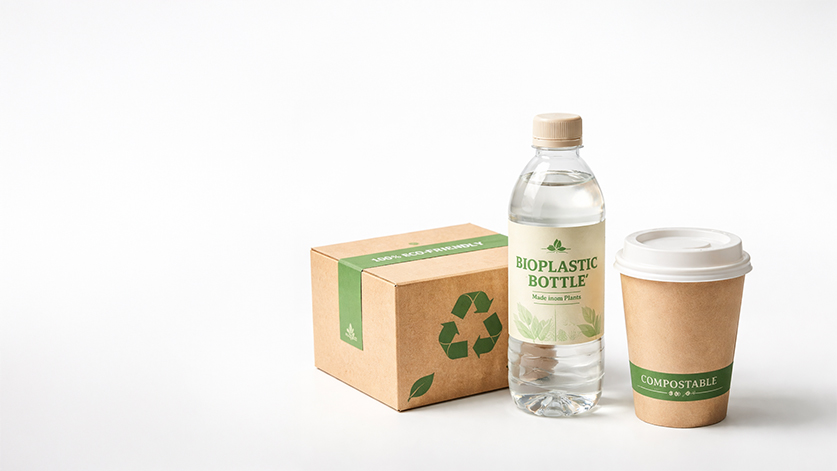
If you have a label that sounds anything like "Eco-Friendly Packaging” you need to be able to know according to which standard. If you claim it's compostable, you need to be able to prove it with a certification. You need to know if it is Industrial or home compostable. What's the certification number.
If you don’t have the answers now, it costs you nothing. The same conversation with a regulator after September 2026 could cost you the product launch, your reputation, and a significant fine. The EmpCo Directive is coming, and it will fundamentally change what you can say about your packaging - and what you cannot. (And we love it!)
This post breaks down what the directive actually requires, why vague sustainability language is now a legal liability, and how converters and packaging engineers can prepare their claims to survive regulatory scrutiny.
What the EmpCo Directive Actually Prohibits
The Empowering Consumers for the Green Transition Directive entered force across the EU in March 2024. Member states must transpose it into national law by September 2026. In Germany, for example, this means amendments to the Unfair Competition Act (UWG). The timeline is tight, and the rules are specific.
The core principle is deceptively simple: if you make an environmental claim, you must prove it immediately and specifically on the same medium where the claim appears.
Here is what becomes prohibited or restricted:
- Generic environmental terms without specification: "Eco-friendly," "green," "sustainable," "environmentally sound," "climate-friendly," and "biodegradable" are no longer permitted as standalone claims unless they reference a recognized certification or are immediately specified with verifiable details.
- Climate-neutral claims based on offsetting: You cannot call a product "climate-neutral" or "carbon-neutral" if that claim relies on carbon offsetting. Offsets may be communicated as a separate commitment, but the neutrality cannot be attributed to the product itself.
- Self-issued labels without independent certification: That green leaf logo your design team created? If it is not backed by a third-party certification system with independent monitoring, it is now impermissible.
- Forward-looking claims without a published plan: Statements like "carbon-neutral by 2030" require a detailed, publicly accessible plan with measurable interim targets, allocated resources, and regular independent audits with published results.
- Cherry-picking: If your environmental claim applies only to the packaging but not the product inside, you must state that clearly. "Sustainable packaging" is not the same as "sustainable product."
The directive also targets what it calls "irrelevant benefits" - claiming credit for actions that are legally required anyway. If a regulation mandates that your packaging contains no specific harmful substance, advertising its absence as a voluntary environmental benefit is now considered unfair practice.
Why "Biodegradable" Is the Most Dangerous Word in Packaging
At LAM'ON, we have watched the word "biodegradable" cause more confusion - and now more legal exposure - than any other term in sustainable packaging.
Here is the problem: "biodegradable" describes a process, not a result. Under unspecified conditions, almost everything is biodegradable eventually. A conventional plastic bag will biodegrade - it just takes 500 years and leaves microplastic residues throughout the process.
The EmpCo Directive does not ban the word. But it requires immediate, clear specification. What conditions? What timeframe? What residues? According to which standard?
This is where certified compostable materials offer a clear advantage - not because they are inherently "better," but because they come with defined answers to those questions.
EN 13432, the European standard for packaging recoverable through composting and biodegradation, specifies exactly what "compostable" means: disintegration within 12 weeks, biodegradation within 6 months, no ecotoxicity, and defined limits on heavy metals. When a packaging film carries OK Compost Industrial or OK Compost Home certification, those claims are backed by third-party testing under controlled conditions.
Under EmpCo rules, "certified compostable according to EN 13432" is a defensible claim. "Biodegradable" alone is not.
How to Audit Your Packaging Claims Before the Deadline
For converters, print houses, and packaging engineers, the next 18 months should include a systematic claim inventory. Here is a practical framework:
- Step 1: Collect every environmental claim currently in use. This includes packaging copy, marketing materials, website language, sales presentations, and trade show materials. Look for any term that implies environmental benefit: sustainable, eco-friendly, green, recyclable, biodegradable, compostable, climate-neutral, reduced carbon footprint, plant-based, renewable.
- Step 2: For each claim, document the evidence chain. The evidence chain follows this structure: Define the claim precisely. Identify the evidence type (certification, test data, LCA study, third-party audit). Add context and conditions (under what circumstances is this true?). State the boundaries (what does this claim NOT include?).
- Step 3: Check whether specification appears on the same medium. If your packaging says "compostable," the certification mark, standard number, and conditions (industrial vs. home) must appear in the same visual field - not buried in fine print on a website.
- Step 4: Remove or replace non-compliant claims. This is where difficult decisions happen. Some claims will need to be dropped entirely. Others can be reformulated with proper specification. A few will require obtaining certifications that currently do not exist for your materials.
- Step 5: Establish a cross-functional approval process. Environmental claims should never be approved by marketing alone. A sustainable claim approval workflow should include marketing, sustainability/technical, and legal review. At LAM'ON, we recommend documenting this process and maintaining records of the evidence reviewed for each approved claim.
What This Means for Converter-Brand Relationships
The EmpCo Directive will change the conversation between converters and brand owners. Brands will increasingly ask for documentation that supports the claims they want to make. Converters who can provide certification numbers, test reports, and clear specification language will have a competitive advantage.
We see this already. Procurement teams are no longer asking "Is it sustainable?" They are asking "What certifications does it carry? What are the test conditions? Can we defend this claim to an auditor?"
This is a healthy shift. It moves the industry away from vague aspiration and toward verifiable performance. At LAM'ON, our certified compostable films come with the documentation that makes compliant claims possible: EN 13432 certification, OK Compost (Industrial or Home) marks, barrier data sheets, and clear guidance on appropriate end-of-life pathways.
The Opportunity Hidden in the Regulation
Regulation often feels like constraint. But the EmpCo Directive also creates opportunity - for companies willing to invest in genuine verification rather than vague language.
When every competitor must prove their claims, the companies with real evidence stand out. When self-issued labels disappear, recognized certifications carry more weight. When "climate-neutral" offsetting claims are prohibited, genuine emissions reductions become differentiators.
For converters and brands working with certified compostable materials, this is the moment to ensure your claims are audit-ready. Document your certifications. Train your teams on proper claim language. Build the evidence chain before you need it.
September 2026 is closer than it feels. The brands and converters who prepare now will not just avoid penalties - they will build the credibility that lasts beyond any single regulation.
If you are reviewing your packaging claims and want to understand how certified compostable films fit into a compliant communication strategy, we are happy to share what we have learned. No green without numbers. No claims without proof.